

NEWS
Eurasian Watermilfoil Decision - Notes from Hearing
Margaret’s (Meg) notes…
In today’s hearing, the judge expressed significant concern that the WDNR did not independently evaluate the 2026 Half Moon Lake permit application. Instead, the judge indicated that the agency appeared to deny the application based on its perceived similarity to the denied 2025 application.
The judge referenced an email exchange among Tyler Mesalk, Brandon Thill, and James Yach, the Secretary’s Director of the Northern Region. In that exchange, the parties discussed how similar the 2026 application was to the 2025 application. One participant commented that the decision should be quick because the two applications were so similar and the 2025 application had been denied. The permit denial followed shortly after that exchange.
The judge stated that he is substantially concerned the 2026 application was not reviewed on its own merits. If that is the case, he indicated that the WDNR failed to follow the law and made an arbitrary and capricious decision that was not based on the 2026 application and was unfair to the Half Moon Lake Protection and Rehabilitation District.
The judge also highlighted key differences between the applications, including a document prepared by Meg Rattei of Barr Engineering Co. for the 2026 permit application. The document detailed the WDNR’s reasons for denying the 2025 application and presented substantial evidence challenging those reasons.
He noted that the 2025 and 2026 denial letters were similar and that there was no evidence the WDNR had considered the new information in the 2026 permit application.
As a result, the judge remanded the 2026 permit application to the WDNR and ordered the agency to review the application independently and make a permitting decision based solely on the 2026 application.
The judge ordered the WDNR to issue its permitting decision within 30 days. Legal counsel for our client then asked whether the judge would retain jurisdiction while the WDNR conducted its review. The judge clarified that he will retain jurisdiction over the case.
Margaret Rattei
Senior Biologist
Barr Engineering
Eurasian Watermilfoil Update - New Hearing Scheduled
Please see the Attorney Document (Link) in relation to the Eurasian Watermilfoil case for Half Moon Lake.
Notice
EWM was discovered in Half Moon Lake, Polk County near the main public landing in fall 2021. The Half Moon Lake Protection and Rehabilitation Board applied for and received a DNR permit to treat the small area of EWM with herbicide, which was completed and successful in reducing the amount of EWM in 2022. Plant bed surveys were completed pre and post treatments. The EWM continued to spread, so the HMLPRD Board, upon the will of the membership, implemented their decision to apply for permits to treat the spreading EWM with herbicide in 2023, 2024, 2025, and 2026.
The Wisconsin DNR has denied the permits for 4 years in a row to treat the EWM with herbicide. The HMLPRD Board, with recommendation from Barr engineering, the experts providing permit application guidance, decided to bring a lawsuit against Wisc. DNR. This website has many studies and reports regarding attempts to gain herbicide treatment approval from the DNR.
Judge Anderson, Polk County Circuit Court, is scheduled to give his decision on October 1st at 3PM in Polk County Judicial Center. All are welcome to attend to show their support. Please contact any Board members with questions.
Court Hearing is also available to be view online via Zoom. Here is the necessary information to log onto the meeting:
MEETING LINK: https://wicourts.zoom.us/j/92098120094
MEETING ID: 920 9812 0094
NOTE: Please update screen name to your first and last name or case number you are appearing for. If the court cannot identify you, you may not be brought into the hearing.
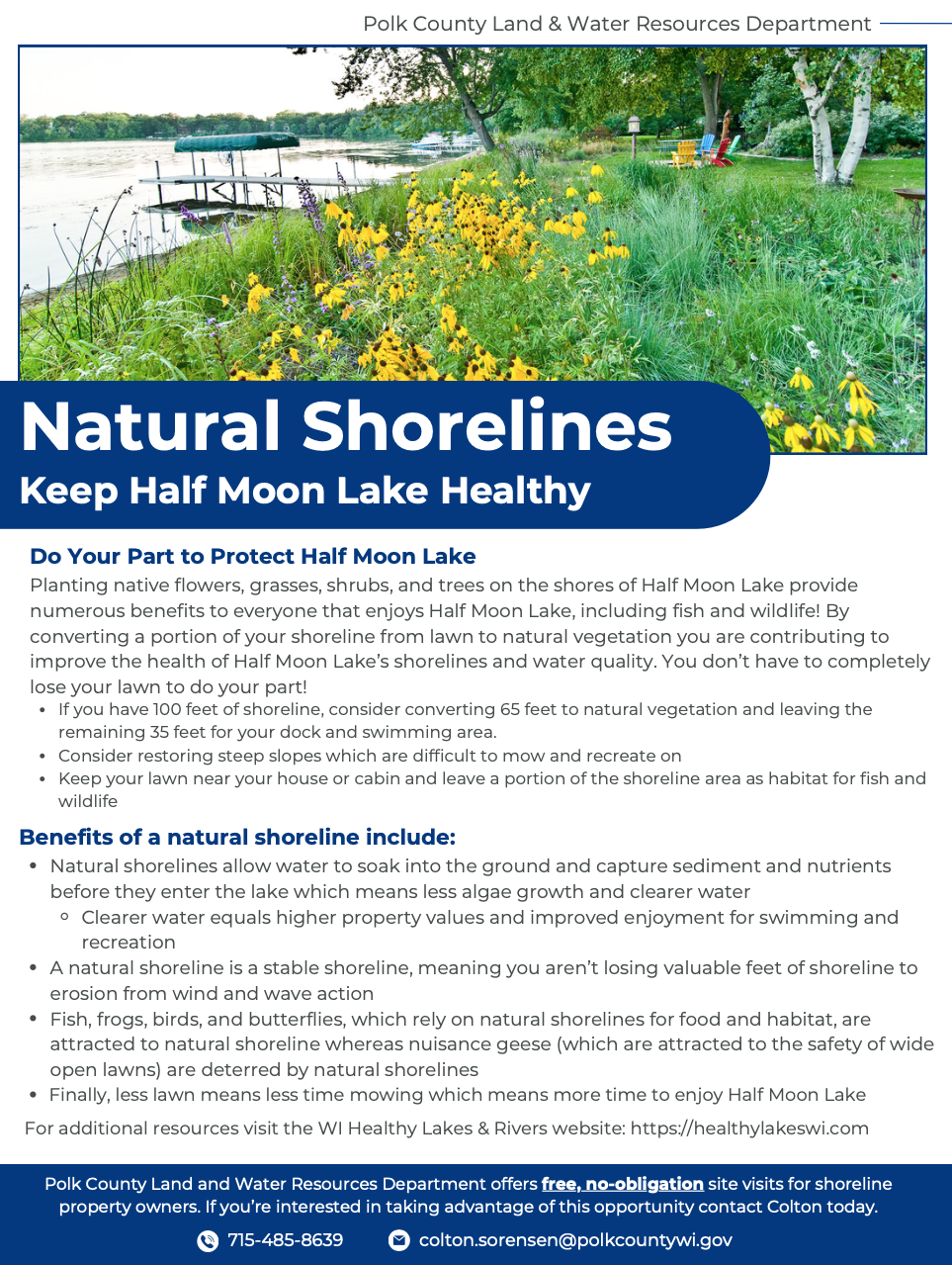
Natural Shorelines
Polk County Land & Water Resources Department created a document detailing ways to have Natural Shorelines. Please see the document below for more details.
Loon Report
Half Moon Lake was again fortunate to have two pairs of loons return to our lake shortly after ice out. Both pairs of loons mated and were on nests by the 23 rd of May, one on the north end and one on the south end of the lake. It takes approximately 25-28 days of incubation for the eggs to hatch. The good news is that on the 21 st of June, a single chick hatched on the south end of the lake and is doing well. We know that the loons on the north end of the lake were nesting on two eggs. The unfortunate news is both those loons were off the nest with no chicks as of June 27 th . Most likely a mid-June storm washed away the nest or a predator got to the eggs.
For those of you new to the lake, you may see groups of adult loons on the lake in August where they socialize before they begin their migration to the Gulf of Mexico by about mid-September. The juvenile chick will remain until late October or November gaining weight and strength and perfecting its ability to fly before leaving. Please remember to stay at least 200 feet away from loons and their chicks when taking part in lake activities. I continue to report annually the loon activity on Half Moon Lake to the “Loon Watch Advisory Council” in Ashland, WI. If you have any questions regarding loon behavior, please feel free to contact me and I’ll do my best to answer them. (E-mail me at tmechelke@gmail.com)
Pat Mechelke
Eurasian Watermilfoil Update
Update on 7-24-2026
Polk County Circuit court hearing: Judge Anderson postponed his decision on our lawsuit to 8-18-2026, 3 pm.
Please see the Attorney Document (Link) in relation to the Eurasian Watermilfoil case for Half Moon Lake.
Notice
EWM was discovered in Half Moon Lake, Polk County near the main public landing in fall 2021. The Half Moon Lake Protection and Rehabilitation Board applied for and received a DNR permit to treat the small area of EWM with herbicide, which was completed and successful in reducing the amount of EWM in 2022. Plant bed surveys were completed pre and post treatments. The EWM continued to spread, so the HMLPRD Board, upon the will of the membership, implemented their decision to apply for permits to treat the spreading EWM with herbicide in 2023, 2024, 2025, and 2026.
The Wisconsin DNR has denied the permits for 4 years in a row to treat the EWM with herbicide. The HMLPRD Board, with recommendation from Barr engineering, the experts providing permit application guidance, decided to bring a lawsuit against Wisc. DNR. This website has many studies and reports regarding attempts to gain herbicide treatment approval from the DNR.
Judge Anderson, Polk County Circuit Court, is scheduled to give his decision on July 24 th 10am in Polk County Judicial Center. All are welcome to attend to show their support. Please contact any Board members with questions.
Court Hearing is also available to be view online via Zoom. Here is the necessary information to log onto the meeting:
MEETING LINK: https://wicourts.zoom.us/j/92098120094
MEETING ID: 920 9812 0094
NOTE: Please update screen name to your first and last name or case number you are appearing for. If the court cannot identify you, you may not be brought into the hearing.
NEW Polk County Boating Viewer Released
The Polk County Land and Water Resources Department is excited to launch the Polk County Boating Viewer which can be accessed at:
This interactive map allows users to visualize the State of Wisconsin slow no wake regulations, permitted buoys marking hazards, and areas suggested by lake organizations for enhanced wake activities. The map also includes Polk County ramp and carry-in boat access locations. The site includes:
Boat landings: includes lake name, type, lanes, surface, dock, parking, restrooms
Waterbodies: includes lake name, max depth, class, acres, and shoreline miles
Slow no wake areas
100 foot buffer from shore: State regulations require all watercraft to be slow no wake within 100 feet of shore, dock, raft, pier, or restricted area
200 foot buffer from shore: State regulations require personal watercraft to be slow no wake within 200 feet of shore
Additional slow no wake designations
Water hazards marked by buoys (rocks or shallow areas)
Not all hazards are marked by buoys or maps; caution should be used when navigating any waterbody as water depths can vary
Suggested enhanced wake areas are designated for select lakes
These areas have been designated by the lake organization affiliated with the waterbody
These areas are suggested to reduce impacts on the lake
This viewer has been designed as an educational resource and is not designed or intended to be used as the only source of navigation.
DNR To Host Open House At Governor Tommy G. Thompson State Fish Hatchery Sept. 27
SPOONER, Wis. – The Wisconsin Department of Natural Resources will host an open house event at the Governor Tommy G. Thompson Fish Hatchery in Spooner on Saturday, Sept. 27 beginning at 10 a.m.
This free open house will give event goers a chance to see musky and walleye up close and personal and will feature family fun activities and guided hatchery tours. Attendees will be able to see fish pumping demonstrations, a fish stocking truck, participate in various family-oriented games and more.
The Governor Tommy G. Thompson fish hatchery is the state's largest cool water hatchery. Every year, the walleye and muskellunge raised at the hatchery are stocked into waters across the state to help sustain fish populations.
More information on the open house is available on the DNR Events Calendar.
EVENT DETAILS
What: Governor Tommy G. Thompson Fish Hatchery open house
When: 10 a.m. – 2 p.m. Saturday, Sept. 27
Where: Governor Tommy G. Thompson Fish Hatchery
951 West Maple St.
Spooner, WI 54801
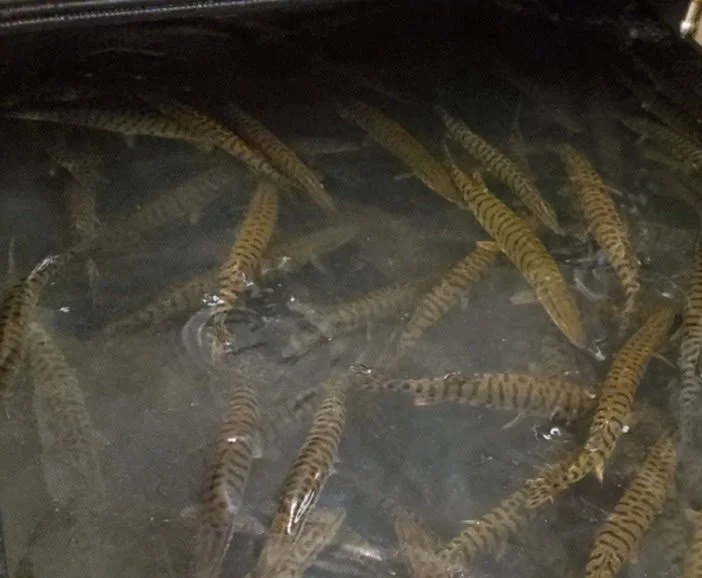
The Governor Tommy G. Thompson fish hatchery is the state's largest cool water hatchery. / Photo Credit: Wisconsin DNR
More HML Maps Available
The board had more 2025 HML maps made, since they ran out at the annual lake meeting. If you missed out on a map or would like to get one, please reach out to Ellen Butler at: ellenbutler1912@gmail.com
Lake maps are updated every 2-3 years. If you have any changes or updates, please let Ellen know at the email address above.
Letter from District Resident: Marty Guinee
Half Moon Lake neighbors,
My name is Marty Guinee. My wife, Gloria, our kids and I have had the joy of owning a cabin at the south end of the lake for a little over three years now.
I’m writing to introduce myself because I won’t be able to attend the upcoming annual meeting. Unfortunately, I’ll be at a funeral that Saturday morning. While I’m sorry to miss seeing you in person, I wanted to share a little about myself and why I’m running to serve on the Half Moon Lake Rehabilitation District.
One of the reasons my family was so excited to buy on Half Moon Lake, beyond its natural beauty, was the strong sense of community engagement and care for the lake itself. That was clear from my first conversation with Bud Ericksen, a former District member, who spoke with passion about the real work happening here on water clarity, invasive species, etc. Over the years, that sense has only deepened. It’s clear that this is a community of people who care about protecting something we all love.
I believe in sharing the responsibility of that work, and therefore I’m interested in serving on the Half Moon Lake Rehabilitation District.
When we’re at the cabin on weekends, you’ll usually find us slowly cruising the shoreline in our pontoon. If you see us out there, don’t hesitate to wave us down, there’s a good chance we’ll have a cold beer or soda in the cooler to share.
Outside of cabin life, we live in Stillwater, MN; I run a graphics manufacturing business in St. Paul and Gloria is a professor in the Social Work department at UW - River Falls.
I’d truly appreciate your support in the election, and I encourage everyone to get involved in any way you can. Together, we can preserve and protect our beautiful Half Moon Lake!
Warm regards,
Marty Guinee

Eurasian Watermilfoil Management Denied Again
The DNR has denied the Eurasian watermilfoil management plan again. The letter dated June 24, 2025, stated:
“The Department has reviewed your application to chemically treat 234.90 acres of aquatic vegetation in Half Moon Lake in Polk County. After careful consideration, your permit application does not meet the minimum requirements by law.
This decision is consistent with conversations the Department has had with Half Moon Lake Protection and Rehabilitation District. Department staff provided comments regarding application of Fluridone to Half Moon Lake and alternative considerations for Eurasian watermilfoil (EWM) management on Half Moon Lake on January 15th and February 24th of 2025.”
The board will meet again soon to determine next steps.